
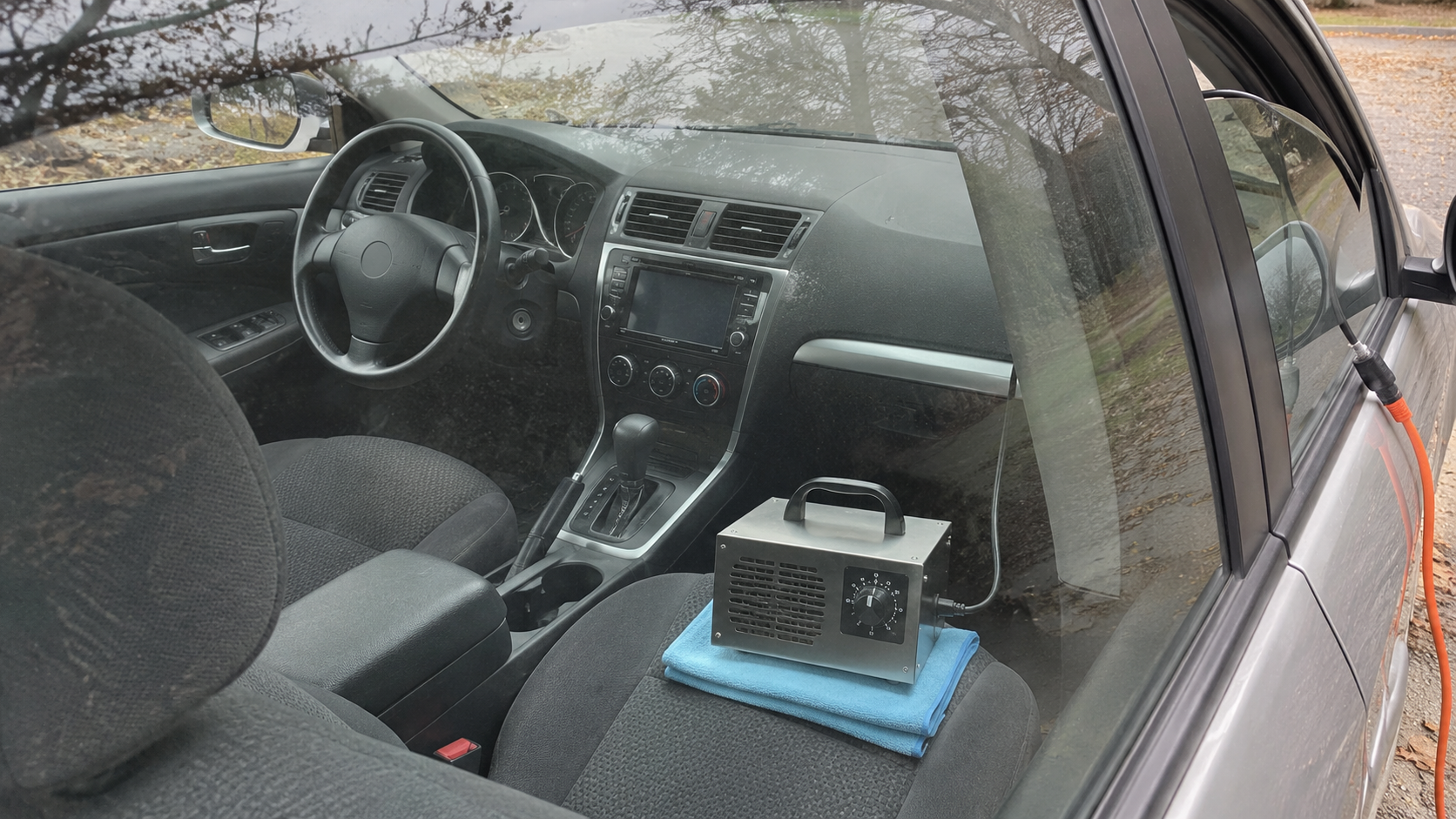
Ozone treatment is one tool for stubborn cabin odors. It is not a magic reset button, and it is not safe to run while people or pets are in the car. Used after the source is cleaned, in an unoccupied vehicle, it can help with residual smells. Used instead of cleaning, or at careless concentrations, it disappoints and can irritate lungs.
This is the method page for people searching ozone by name. For the wider “find the smell” playbook, use how to get a bad smell out of your car. Here we cover when ozone belongs in a car odor job, what the EPA says about ozone generators sold as air cleaners, how our Odor Treatment from $134.99 uses source-first methods (including ozone when they fit), and when mold or biohazard pricing applies instead.
TL;DR
- Clean the source first. Ozone on a dirty cabin wastes the visit.
- The car must be unoccupied. People and pets stay out during treatment and until the cabin has aired out.
- Odor Treatment starts at $134.99 with about three hours reserved. Ozone is one method among others on that service, not a separate menu price on the live site.
- EPA guidance on ozone generators sold as air cleaners warns that ozone is a lung irritant and that odor claims often fail at concentrations that would be safe for occupied spaces.
- Mold, urine and other contamination use their own price lists after photos.
Table of Contents
- What ozone does in a car cabin
- What the EPA says (read this before you DIY)
- When ozone helps
- When ozone does not help
- How our Odor Treatment uses it
- Price, time and what to expect
- DIY ozone machines: risks
- Pairing ozone with an interior detail
- Smoke vs food vs musty: different ozone odds
- Ventilation and re-entry
- How this compares to enzyme cleaners and foggers
- Questions to ask any shop before an ozone visit
- Our perspective: tool, not promise
- Having us handle it
- FAQ
- Sources
What ozone does in a car cabin
Ozone (O₃) is a reactive gas. In odor work, the idea is that it oxidizes odor-causing compounds on surfaces and in air. In a car, that means a sealed cabin, a machine that produces ozone for a set time, then a long air-out before anyone sits inside.
It does not vacuum crumbs, extract milk from foam or remove a dead rodent. Those are physical jobs. If the reservoir is still there, odor often returns after the ozone smell itself fades.
What the EPA says (read this before you DIY)
The U.S. EPA’s page on ozone generators sold as air cleaners is blunt: ozone is a lung irritant, and at concentrations that do not exceed public health standards, ozone applied to indoor air may not effectively remove many odor-causing chemicals. Some machines can produce levels well above those standards. The related EPA page on ionizers and other ozone-generating air cleaners notes FDA guidance limiting ozone from medical devices to 0.05 parts per million.
Takeaways for car work:
- Never occupy the car during treatment.
- Do not treat ozone as proven to “remove all odors” at safe levels.
- Prefer source cleaning; use oxidizers as a residual step when the job calls for it.
- Air the cabin thoroughly afterward.
That honesty is why our odor page does not sell a blanket removal guarantee before inspection.
When ozone helps
Ozone is most useful when:
- Soft surfaces have already been cleaned and still carry a residual smoke or organic smell.
- The source was diffuse (smoke throughout the headliner and vents) rather than a single wet spill under one seat.
- The car can sit sealed and empty for the treatment window, then air out.
- You accept improvement as the goal, not a factory-new scent.
Smoke jobs and some food-odor leftovers after extraction are the usual candidates. Pet urine that has soaked padding may need contamination work first; ozone alone will not rebuild padding.
When ozone does not help
Skip ozone-as-first-step when:
- Trash, spilled food or wet gear is still in the car.
- You can point to a wet stain that has not been extracted.
- Visible mold is present. That is a mold removal path with photos first ($299.99 to $449.99 light to moderate; $549.99 to $1,000 severe).
- Bodily fluids are involved. That is biohazard from $249 per affected area.
- Someone plans to sit in the car during or immediately after a heavy cycle.
- The “odor” is mostly a dirty cabin filter blowing old air. Change the filter; do not ozone a clogged filter and call it done.
The EPA’s indoor-pollutant overview also reminds readers that many consumer products emit VOCs. Stacking fragranced sprays on top of ozone is not a plan.
How our Odor Treatment uses it
Our live odor removal page describes source-first treatment. Methods can include ozone, enzyme cleaners or an odor fogger, chosen after we see what you are dealing with. The visit starts at $134.99 and reserves about three hours. That starting price covers Odor Treatment. Ozone is not priced as a separate service.
Typical order of operations:
- History and inspection.
- Clean or treat the physical source (extraction, enzymes, wipe-down of affected materials).
- Decide whether an oxidizer step is still useful.
- If ozone is used, the car sits empty; then we air it out and recheck.
- Dry-down and filter advice before you take the car back into daily use.
If the cabin is filthy, we will steer you toward an interior detail (Express from $174.99, Executive from $284.99 for a sedan) in addition to or instead of jumping straight to oxidizers. See how to get a bad smell out of your car for the broader source-first playbook.
Price, time and what to expect
| Item | Figure |
|---|---|
| Odor Treatment starting price | $134.99 |
| Time reserved | About 3 hours |
| Sedan Express Interior (if also needed) | From $174.99 |
| Sedan Executive Interior (if also needed) | From $284.99 |
| Mold (if growth present) | $299.99-$449.99 or $549.99-$1,000 |
| Biohazard (fluids) | From $249 per affected area |
You should expect a confirmed scope after inspection, not a text-message promise that “ozone fixes everything.” Smoke that lived in a cabin for years often improves a lot and still is not perfume-ad neutral. That is a realistic outcome, not a failed job.
DIY ozone machines: risks
Consumer ozone units are easy to buy and easy to misuse. Risks include:
- Running a cycle with a person, child or pet nearby.
- Treating an attached garage and drifting ozone into living space.
- Believing a short cycle replaces extraction.
- Rubber and soft-material sensitivity shows up if concentrations and dwell are extreme, which is another reason pros control dose and time.
If you already ran a DIY cycle and the smell remains, say so when you book so we know what chemistry the cabin has already seen.
Pairing ozone with an interior detail
Best results usually look like: deep clean first, oxidizer second. An Executive Interior handles extraction and steam where the material allows; odor treatment handles residual smell. Booking both in one request lets us schedule enough hours so the car is not rushed.
A full Inside & Out cleans paint and cabin together but still treats dedicated odor work as its own specialty when smell is the main complaint. See full car detail.
Smoke vs food vs musty: different ozone odds
Smoke. Best residual candidate after a real clean of soft surfaces and a cabin-filter change. Years of smoking may still leave a faint note in heat. Improvement is success; perfume-ad zero is marketing.
Food and drink. Extraction and enzymes do most of the work. Ozone is optional leftover insurance after the foam is actually clean and dry.
Musty / damp. Fix water first. Ozone will not dry padding or stop a sunroof drain from refilling the smell. If you see growth, switch to the mold menu before any oxidizer talk.
Pets. Hair and dander clean mechanically. Urine is contamination chemistry. Ozone is not a substitute for either.
Ventilation and re-entry
After a cycle, open doors and trunk. Let the cabin exchange air until it smells like outdoor air, not like sharp ozone. If you are sensitive to smells or have asthma, give it extra time and consider having someone else move the car out of a closed garage. Do not sleep in the vehicle the same night as a heavy treatment.
Cabin filters can hold odor. Replacing a due filter after smoke or pet jobs stops the HVAC from blowing the old smell back into a cleaned cabin. Filter replacement is routine owner maintenance on most cars. We can advise you, but we do not list a price for filter replacement.
How this compares to enzyme cleaners and foggers
Enzyme cleaners digest organic residues when they can reach them. Foggers distribute product through the cabin volume. Ozone oxidizes. Pros pick based on what the inspection shows, not based on which word trends on social media. Our odor page lists those methods together on purpose: the visit is source-first treatment, not an ozone product page.
If a previous shop “ozoned it” and the smell returned in a week, assume the source was never removed. Bring that history to the booking notes.
Questions to ask any shop before an ozone visit
- Do you clean the source before running ozone?
- Will anyone be in or near the car during the cycle?
- How long do you air the cabin afterward?
- What happens if you find mold or bodily fluids during inspection?
- Is ozone included in the odor price or billed as a surprise add-on?
Clear answers to those five questions matter more than a dramatic before-and-after video. Our answers: source first; car empty; air-out required; mold and biohazard move to their own menus with photos; Odor Treatment starts at $134.99 with methods chosen after inspection.
North County heat can make residual odors bloom again in the afternoon even after a good morning treatment. That is chemistry and temperature, not automatically a failed visit. If a specific corner returns, we want to know which seat or carpet zone so a follow-up targets a pocket, not the whole cabin at random.
Our perspective: tool, not promise
— Julian
I use ozone when the cabin has been cleaned and something stubborn is left, and only when the car can sit empty. I will not sell it as a cure for a milk shake still sitting in the foam or for mold you can photograph. If photos show contamination, we move to the right menu before a deposit. If you want honesty more than hype, that is the deal.
Having us handle it
Book from odor removal. Describe the smell, history and any DIY ozone you already tried. Add photos of stains or growth. For cabin deep cleans around the odor visit, use interior detailing or the interior guide.
If you are comparing shops, ask whether ozone is used only after cleaning, whether the car sits empty, how long air-out lasts, and whether mold or biohazard cases are screened from photos before a deposit. Those four questions separate a careful odor visit from a machine rental with a cabin attached.
FAQ
How much does a car ozone treatment cost?
We book Odor Treatment from $134.99. Ozone may be part of that visit when appropriate. We do not price it separately.
Does ozone remove smells permanently?
Not reliably by itself. If the source remains, smells return. Even after a good visit, heavy smoke history may not return to factory-neutral.
Is ozone safe?
Not while occupied. EPA materials describe ozone as a lung irritant. We treat unoccupied cars and air them out afterward.
Can I sit in the car during treatment?
No. People and pets stay out until the cabin has been aired.
Will ozone kill mold in my car?
Visible mold is a mold-removal job with photos first, not an ozone-only booking.
Should I clean the car before ozone?
Yes. Source cleaning first is the difference between a useful cycle and an expensive breeze.
Sources
- Ozone Generators That Are Sold as Air Cleaners (U.S. EPA)
- What Are Ionizers and Other Ozone Generating Air Cleaners? (U.S. EPA)
- Volatile Organic Compounds’ Impact on Indoor Air Quality (U.S. EPA)
- Indoor Pollutants and Sources (U.S. EPA)
- Mold Cleanup in Your Home (U.S. EPA)
- About Mold Cleanup (CDC)